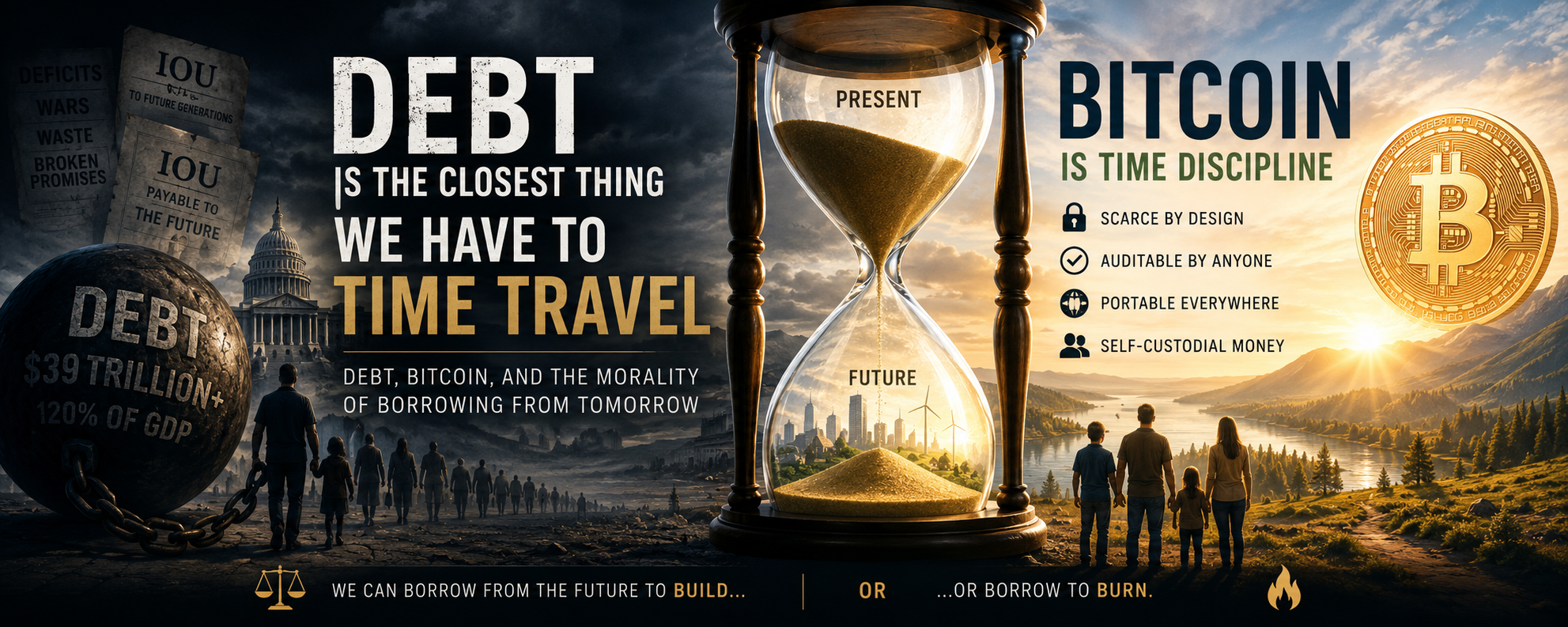
In the May 11, 2026 episode of Mailbag Monday, Jack Mallers, CEO of Strike and XXI, made a
fascinating observation:
“Debt can be thought of as the closest thing we have to time travel.”
It is a simple idea, but once you sit with it, it becomes profound.
At the individual level, debt allows us to pull future purchasing power into the present. When
we take out a loan, we are not creating value from nothing. We are consuming or investing
today, with value our future self must produce tomorrow.
At the national level, the idea becomes even more morally serious.
When governments borrow, they are not merely moving numbers on a balance sheet. They are
reaching into the future and placing a claim on the labor, productivity, and tax revenue of
citizens who may not even be born yet.
Which raises a moral question:
If we borrow from the future, what does the future receive in return?
In this essay, we will explore debt as a form of economic time travel, first at the individual level,
then at the level of the state. We will examine the difference between productive debt and
destructive debt, the growing burden of interest, and why Bitcoin may offer a path toward
restoring what we might call “time equilibrium”.
The Individual And Debt
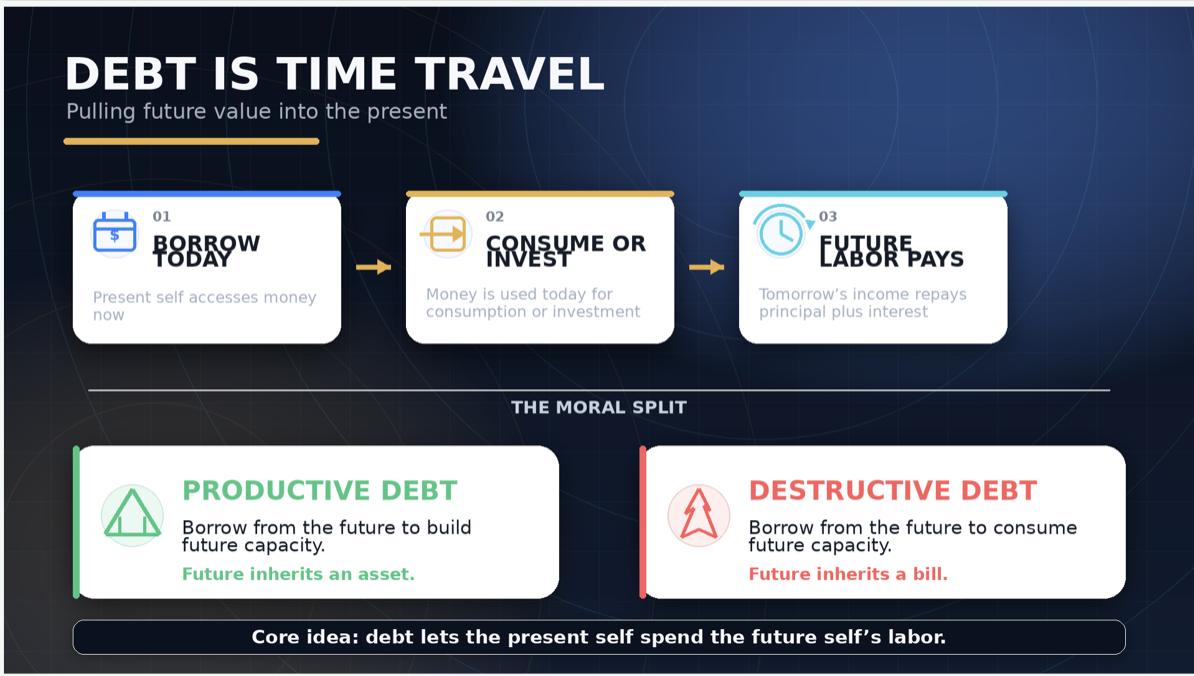
It’s perhaps easiest to conceptualize this at the individual level, as debt lets you pull future
purchasing power into the present. For example, when you take out a loan, you are consuming
today with the value your future self must produce tomorrow.
All debt “calls forward” earnings from the future; so a mortgage, a business loan, a student
loan, a credit card balance are all forms of economic time travel.
They move value across time.
However, not all debt is bad, it can be wise or foolish, productive or destructive. So it’s
important to consider what the “value being drawn from the future” is being used for.
If you borrow to buy productive tools, start a business, acquire useful skills, or purchase a
home, debt may help you build future capacity. You borrow from tomorrow, but tomorrow
receives something in return.
For example, a serviceable car loan can be productive if the car expands your earning
capacity. Reliable transportation may reduce commute time, widen your job prospects, allow
you to serve more clients, or make your work more dependable. In that case, the debt pulls
value from the future, but it also increases the future self’s ability to repay it.
However, if you borrow to consume, gamble, posture, or escape reality, then tomorrow receives
no asset, and your future-self simply inherits the bill.
For example, if I take out debt to consume non-productive assets like fine jewelry or designer
handbags and status objects. Perhaps I use it for a fun gambling week in Las Vegas, or
vacations at luxury hotels, or to generally finance living a lifestyle beyond what I produce.
These are all ways of consuming debt without any gains in productivity that my future self can
benefit from.
Ultimately, debt lets the present self spend the future self’s labor, and this is as true for
individuals as it is for nations…
The State And Debt
In the same way that the individual borrows from his own future production, the state borrows
from the production of its future citizens. More specifically its ability to tax future citizens, even
citizens not yet born.
So at the national level, debt becomes morally more complicated. When an individual borrows,
at least there is continuity - your present self borrows from your future self. You may regret the
decision later, but it was still you who made it.
Government debt is different. When a state borrows, the people making the decision are often
not the same people who will bear the burden. Today’s voters, politicians, contractors, and
beneficiaries get the spending, but it is tomorrow’s citizens who get the debt.
The U.S. Treasury describes the national debt as the money the federal government has
borrowed to cover expenses incurred over time. When federal spending exceeds revenue, the
government borrows by issuing Treasury securities.
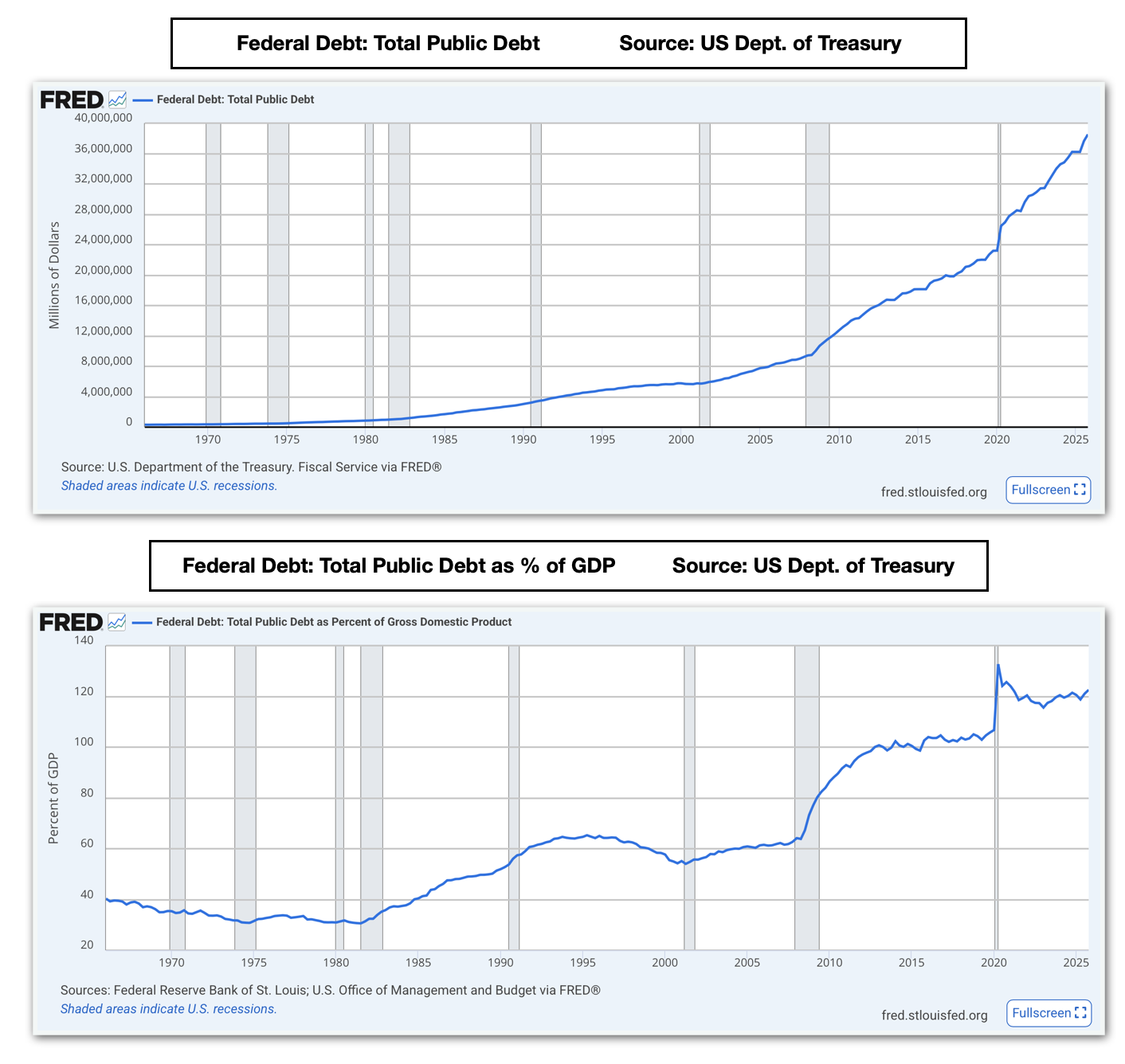
The scale is enormous. Recent Treasury and public-debt dashboards place total U.S. federal
debt near $39 trillion. On the broader gross federal debt measure, total public debt is now over
120% of GDP. A sign that we are not merely borrowing at the margins, but pulling an
enormous amount of future productive capacity into the present
This is not just accounting, It is a claim on future labor, and the claim is huge.
National debt lets today’s voters tax tomorrow’s citizens, and tomorrow’s citizens have no
agency in the process. They did not agree to the expenditures, they did not approve the wars,
they did not negotiate the contracts. Some of them have not even been born yet. Yet they
inherit both the principal cost and the interest burden (more on this later).
They may not be alive to enjoy the service or good that was purchased. They may receive no
productive asset at all. And if the borrowing funded destruction, waste, or political patronage,
the future receives only an invoice.
This leads to the central moral question:
What did the future receive in return?..
The Moral Implications of Debt Spending
Did we borrow to build, or did we borrow to burn?
Because not all debt is the same, borrowing from the future to build the future is very different
from borrowing from the future to consume the future.
This is why Hoover Dam is such a perfect example. It stands as a living monument to what
debt can be at its best: one generation borrowing from the future in order to build something
the future could actually inherit.

Hoover Dam was not merely spending - It was civilization-building. It created hydroelectric
power, water storage, irrigation capacity, flood control, and helped make large-scale
development in the American Southwest possible.
The Bureau of Reclamation says Hoover Dam generates about 4 billion kilowatt-hours of
hydroelectric power each year for Nevada, Arizona, and California, enough to serve roughly 1.3
million people.
That is productive debt logic.
Hoover Dam cost roughly $120–140 million to build, but its power revenues alone repaid that cost with interest by 1987. And electricity was only
part of the return. The dam still generates billions of kilowatt-hours each year, stores water, controls flooding, irrigates farmland, and supports millions
of people across the Southwest. This is the moral case for productive debt: the future did not merely inherit the bill. It inherited the machine that paid
the bill back
If you borrow from the future to build a dam, the future inherits the dam. Future citizens receive
electricity, water management, infrastructure, economic development, and a durable asset that
continues producing value long after the original builders are gone.
That is one moral category of debt.
But there is another…
If a nation borrows from the future to fund wars, destruction, political patronage, contractor
enrichment, or short-term consumption, future citizens may inherit no productive asset at all,
yet they inherit the bill. And this distinction matters.
Since 2001, the United States has spent or obligated roughly $8 trillion on post-9/11 wars and
related costs. That is the opposite of Hoover Dam-style debt. Instead of borrowing from the
future to build enduring productive assets, much of this borrowing funded destruction,
occupation, defense contracts, and interest payments, leaving future citizens with the bill rather
than a desirable enduring legacy.
To understand the scale of $8 trillion, consider this: one trillion seconds is nearly 32,000 years.
Go back one trillion seconds from today and you are not in ancient Rome, Egypt, or even the
earliest cities. You are in the Ice Age, when much of what is now New York was still buried
beneath glacial ice. Now multiply that by eight - that is the scale of the resources consumed by
the post-9/11 war machine: not millions, not billions, but trillions of dollars pulled from the
future.
War debt is especially destructive because war is not merely unproductive, it is anti-
productive: it consumes ships, missiles, fuel, labor, and capital on one side in order to destroy
buildings, infrastructure, assets, and human life on the other, leaving the future with both the
bill and the wreckage.
So the moral question becomes not simply, “How much did we borrow?”
But, did the future inherit an asset or only an invoice?
This is where the debt conversation becomes more than economics - It becomes ethics.
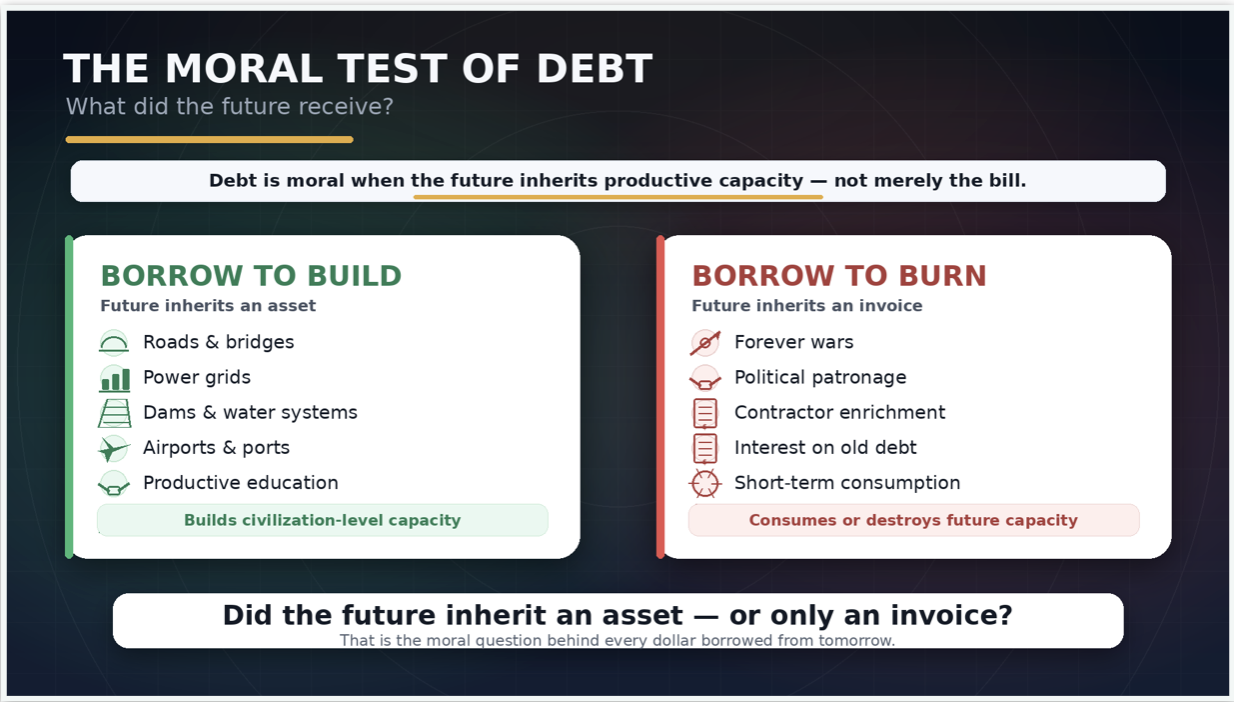
A generation can borrow from the future to build bridges, dams, power grids, water systems,
ports, railways, and productive infrastructure. Or it can borrow from the future to finance
conflicts, subsidies, bureaucracy, and promises that leave no lasting productive capacity.
The first can be a gift to the future. The second is generational theft.
The Compounding Effect Of Interest
Debt becomes even more dangerous when interest enters the story.
At first, a country borrows to spend, then it borrows to cover deficits, then it borrows to pay
interest on what it already borrowed.
At that point, the time machine becomes a trap: “The Debt Spiral”.
The Congressional Budget Office projects that the federal budget deficit will be about $1.9
trillion in fiscal year 2026 and grow to $3.1 trillion by 2036. Relative to GDP, CBO projects the
deficit rising from 5.8% in 2026 to 6.7% in 2036, with rising net interest costs driving much of
that increase.
That is the doom loop:
Deficits
→ more debt
→ higher interest costs
→ larger deficits
→ more borrowing
→ less future flexibility
→ the loop repeats.
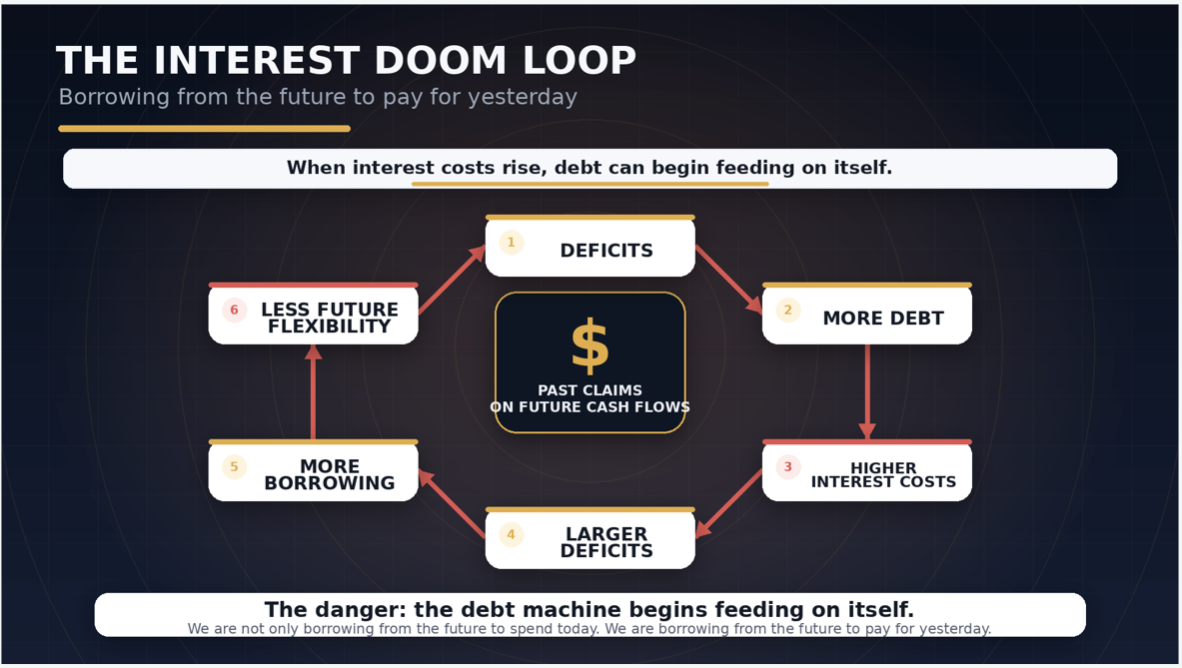
This is alarming, as we are not only borrowing from the future to spend today - we are
borrowing from the future to pay for yesterday.
That is a very different kind of time travel.
It means future citizens are not only financing present consumption. They are servicing the
accumulated decisions of past politicians, past wars, past deficits, and past promises.
There’s an opportunity cost as every dollar spent on interest is a dollar that cannot be spent on
roads, research, schools, infrastructure, energy systems, or tax relief.
Interest is effectively the past taxing the present, and when the present borrows to pay that
interest, the past begins taxing the future too.
Bitcoin and Time Equilibrium
This is where Bitcoin changes the conversation.
Fiat money allows governments to stretch obligations across time in ways that are easy to
obscure. If the state cannot honestly tax enough to pay for what it spends, it can borrow. If the
debt burden becomes too heavy, the system can lean on monetary expansion, inflation,
financial repression, or currency debasement.
The consequences still arrive, but the system allows political leaders to delay (and magnify) the
consequences.
Bitcoin is different. Bitcoin’s monetary policy cannot be changed by politicians, central
bankers, or voters. Its supply is capped at 21 million coins, and its issuance schedule is not
subject to congressional negotiation or central bank discretion.
If time equilibrium means the present cannot endlessly consume value that the future has not
agreed to provide, then Bitcoin preserves time equilibrium because it prevents the present from
secretly diluting the future.
In a fiat system, costs can be hidden:
They can be pushed into deficits.
They can be pushed into inflation.
They can be pushed into monetary debasement.
They can be pushed onto people not yet born.
Bitcoin makes that much harder…
A Bitcoin-based system forces more honesty. If the money cannot be printed, then spending
must be funded more directly. A government must tax openly, borrow honestly from willing
lenders, spend less, or default.
We have lived under a monetary system backed by a scarce asset before: Gold. And for a time,
it worked - Gold imposed discipline because governments could not simply create unlimited
money without reference to a finite reserve asset. It forced a closer relationship between
spending, saving, borrowing, and real resources. But it only worked up to a point.
Because gold was physical, expensive to transport, and difficult to custody, it naturally became
centralized in banks and vaults. Eventually, people did not transact with gold itself but with
paper claims on gold, and once the claims became easier to create than the gold itself, the
discipline began to weaken. Gold proved that scarce money can restrain political excess, but it
also revealed the problem Bitcoin was designed to solve.
Bitcoin restores the link between present spending and present sacrifice; it ties money back to
scarcity. But unlike gold, it is digital, portable, auditable, and self-custodiable, making it far
harder to centralize in vaults, replace with excessive paper claims, and quietly sever spending
via debt from its future consequences.
This has profound moral implications because with Bitcoin, a digital bearer-instrument, the
unavoidable question becomes:
“If the state cannot print the cost into the future, would citizens still choose to pay for this
today?”
That question changes everything.
Bitcoin - Individual Level
Bitcoin changes the debt landscape at the individual level.
In a fiat system, saving is often punished. People work, save cash, and watch purchasing
power erode. Asset prices rise, homes become more expensive, stocks, commodities, land
move further away as all scarce desirable assets absorb monetary premium.
So people feel forced into the “buy assets and leverage the collateral to survive” strategy…
The fiat loop looks like this:
Save cash
→ purchasing power erodes
→ feel forced into assets/leverage
→ borrow to keep up.
So debt becomes a survival strategy. People take on debt not because they are irresponsible,
but because the monetary system makes sitting in cash a strategic disadvantage. The cost of
not using assets as collateral and taking on debt becomes too high.
Bitcoin offers a different possibility.
With Bitcoin, the individual can save in scarce money and preserve purchasing power. It can be
volatile in the short term, but its long-term design is radically different from fiat: no central
bank, no political supply expansion, no hidden committee deciding how much new money the
future must absorb.
The Bitcoin loop looks like this:
Save in scarce money
→ preserve purchasing power over long time horizons
→ reduce dependence on leverage
→ use debt less as a survival strategy.
Fiat makes debt feel necessary, but Bitcoin makes saving possible again.
This is a profound change.
If people can save in money that is not designed to be debased, they may not need to become
leveraged speculators just to protect their future.
They may not need to buy houses primarily as inflation hedges.
They may not need to stretch for assets at any price.
They may not need to borrow just to keep up.
Saving becomes a real option again, and that is not just a financial shift:
It is a moral one.
It is a moral shift because Bitcoin reduces the pressure to borrow from the future simply to
survive the present, while also giving monetary premium a cleaner place to go, potentially
allowing homes to become homes again rather than leveraged savings vehicles priced beyond
the reach of ordinary families.
Bitcoin - State Level
At the state level, Bitcoin challenges the deepest power of fiat money:
The ability to delay consequences.
A government that controls the money can spend beyond current taxation, issue debt, and rely
on the monetary system to absorb the burden over time.
This does not make the cost disappear, it simply makes the cost harder to see.
Inflation is not voted on like a tax bill, and currency debasement is not itemized like a budget
line. The burden spreads through prices, wages, savings, interest rates, and future obligations.
Bitcoin introduces a harder boundary - if a government cannot create the monetary unit at will,
it cannot so easily hide the cost of spending from the people who must bear it.
Wars become harder to obscure.
Promises become harder to overextend.
Infrastructure must justify itself.
Spending must compete with real resources.
Citizens must confront the question:
Is this worth paying for now?
And that is time discipline.
A government that cannot print the future must ask the present to pay honestly.
This does not mean a Bitcoin world eliminates debt. Productive borrowing can still exist and
people and governments may still borrow to build things that create future value.
But the moral equation becomes clearer.
Borrowing from the future becomes more honest when the present cannot debase the unit in
which the future saves.
So rather than eliminating sacrifice, Bitcoin reveals it.
Conclusion
Debt is not just an accounting entry - it is a moral claim across time.
At the individual level, it lets the present self spend the future self’s labor.
At the national level, it lets today’s voters tax tomorrow’s citizens.
That power can be used wisely. A society can borrow from the future to build things to benefit
the future: dams, bridges, power grids, airports, water systems, productive infrastructure, and
institutions that increase human flourishing.
OR
It can borrow from the future to fund destruction, consumption, political favors, and interest on
yesterday’s mistakes.
The question is not whether a nation can borrow from the future: It can.
The question is whether, when the future arrives, our children will find that we built them a
civilization — or merely left them the bill.
Debt is time travel. Bitcoin is time discipline.
It does not make the future free, but it helps prevent the present from stealing from it in secret.
